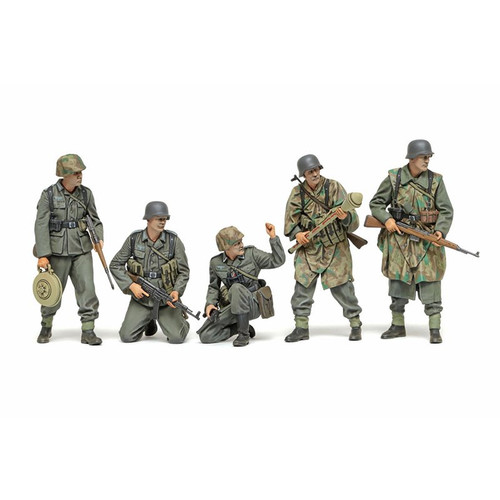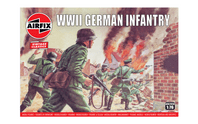
This 1:76 scale figure collection vividly represents Wehrmacht soldiers, featuring meticulously crafted officers, grenade throwers, and other essential figures. Designed to seamlessly integrate with other D-Day themed items in the Airfix series, these 48 unpainted plastic figures provide excellent opportunities for historical diorama enthusiasts and model builders alike.
Key Features
- Set includes 48 unpainted plastic figures
- Precisely scaled at 1:76 to align with other Airfix WWII kits
- Features officers, grenade throwers, and key Wehrmacht figures
- Compatible with additional D-Day items from the Airfix collection
- Suitable for ages 8 and up
- Skill level 1 - perfect for novice modellers
History
The Wehrmacht served as the unified military forces of Nazi Germany from 1935 to 1945, encompassing the Heer (army), Kriegsmarine (navy), and Luftwaffe (air force). During WWII, Wehrmacht infantry units were active in all theatres of war, from the Eastern Front to North Africa, and from occupying Western Europe to defending Fortress Europe after the D-Day invasion.
German infantry divisions typically consisted of three infantry regiments, supported by artillery, reconnaissance, and engineering units, with a full strength of around 17,000 men, though this number fluctuated throughout the war. Wehrmacht troops primarily used the Karabiner 98k bolt-action rifle, with machine guns like the MG34 or MG42 providing squad-level firepower.
By 1944, the German forces protecting the Atlantic Wall and Normandy coast included both seasoned veterans and newly formed divisions. Some units were made up of soldiers with experience from harsh Eastern Front battles, while others included older men, young recruits, or conscripts from occupied regions. Despite this diversity, Wehrmacht infantry remained resolute and tactically skilled adversaries during the Normandy battles.
The German infantry's distinctive appearance was marked by their Feldgrau (field grey) uniforms, coal-scuttle Stahlhelm helmets, and varied personal gear. Officers often carried map cases and binoculars, and wore leather greatcoats, while grenade throwers were equipped with the iconic Stielhandgranate, or "potato masher" grenades.
Infantry tactics focused on leveraging small unit firepower, with squads centred around the machine gun rather than the rifle. This approach, developed during WWI and refined in the interwar years, proved highly effective in both offensive and defensive operations throughout the war.